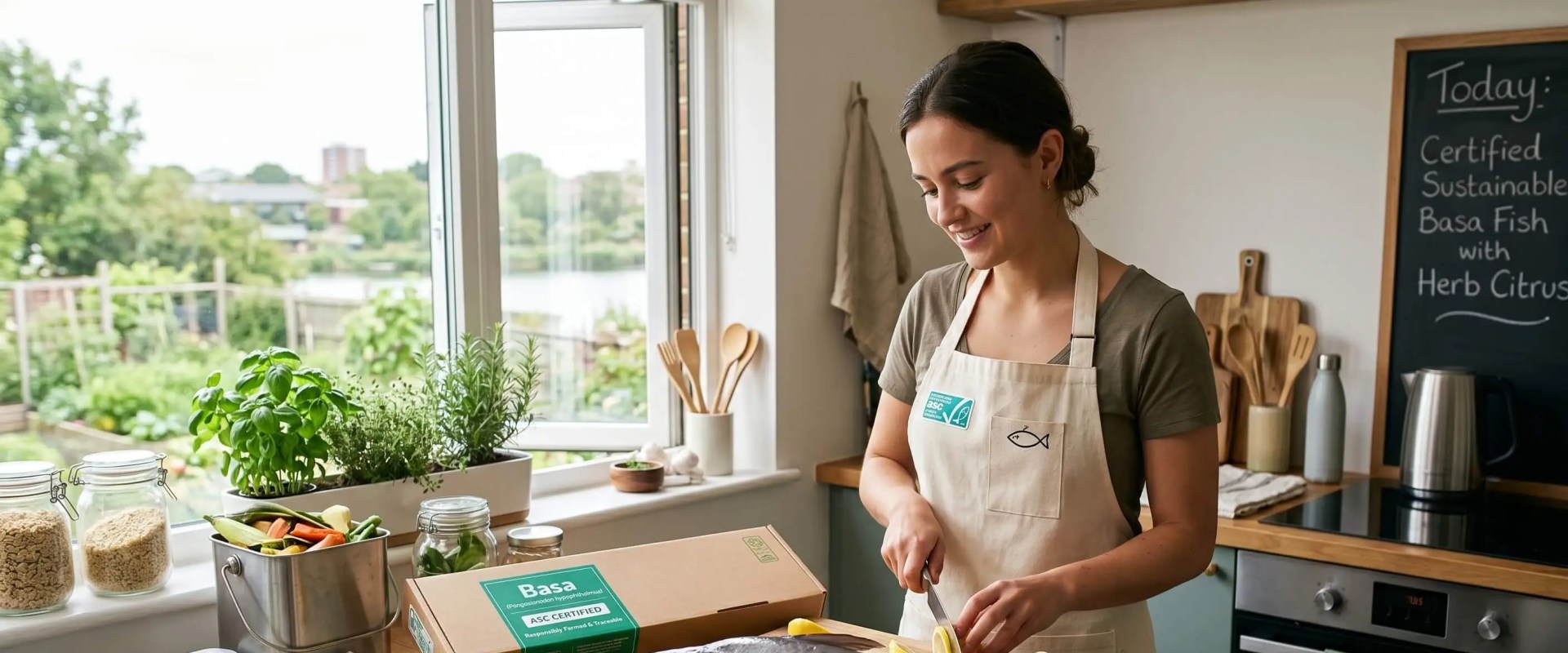
This guide walks through what matters on a basa fish package and how to read one quickly.
TL;DR Quick Answers
basa fish
Basa is a freshwater catfish (Pangasius bocourti) farmed almost entirely in Vietnam's Mekong Delta and sold worldwide as an affordable white fillet. In 2026, whether it counts as sustainable comes down to one thing: certification.
What it is: Freshwater catfish, scientific name Pangasius bocourti
Where it's from: Roughly 90% Vietnam's Mekong Delta
Is it sustainable? Yes if certified (ASC, BAP 3-star or higher, GLOBALG. A.P., or EU Organic). No if uncertified.
Is it safe to eat? Yes. Low mercury meets Western food safety standards when certified.
What it tastes like: Mild, firm white flesh, similar to cod or haddock
Why it's cheap: Fast growth, efficient feed conversion, high-density pond farming
The four-second shelf test: Logo on the front, country on the back, sensible price
Top Takeaways
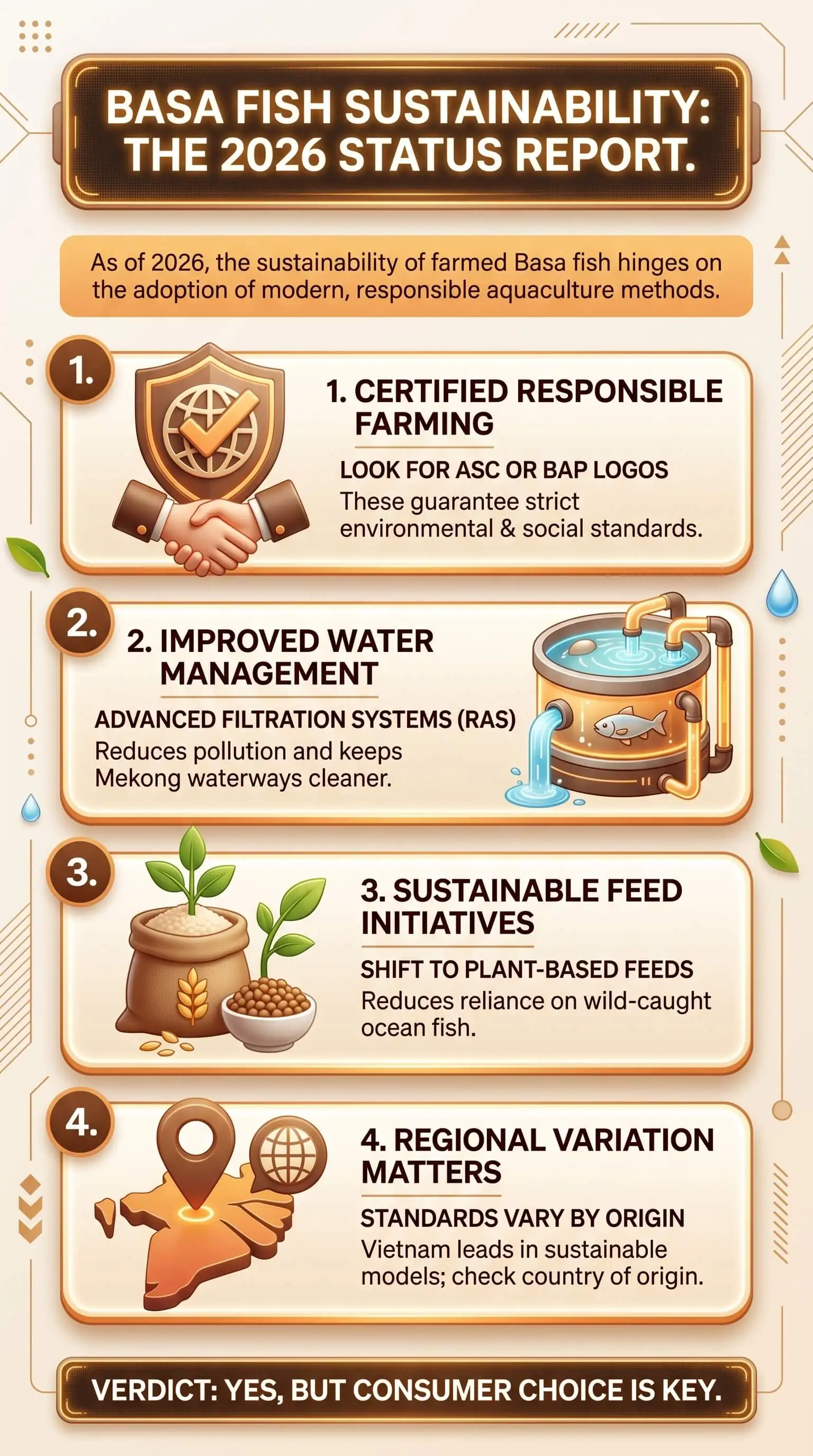
• Certified basa qualifies as a sustainable choice in 2026 when the label carries ASC, BAP at three stars or higher, GLOBALG. A.P., or EU Organic.
• Uncertified basa is amber-rated by the Marine Conservation Society and treated with caution by Seafood Watch. Sustainability claims without third-party verification are marketing language, not evidence.
• The package itself answers most of the questions. Look for a certification logo on the front, country of origin on the back, and a price that holds up against the market for whitefish.
• Basa's biological efficiency, including its fast growth, omnivorous diet, and low feed conversion ratio, gives it a real structural sustainability advantage over most red-meat proteins and many other farmed fish.
• Roughly 90% of global basa supply originates in Vietnam's Mekong Delta, so country-of-origin labeling and traceability matter more here than for almost any other supermarket whitefish.
• When in doubt, switch species. A clearly certified pollock, haddock, or hake fillet is a more reliable sustainability bet than uncertified basa at any price.
Basa is the common-market name for Pangasius bocourti, a freshwater catfish farmed almost entirely in Vietnam's Mekong Delta. About 90% of the world's supply traces back to that one region, which makes how those farms operate the entire conversation.
The 2026 answer comes down to one thing: certification. Basa from a farm certified by an established third-party program qualifies as a defensible sustainable buy. The same species without that certification is a different question, and you can tell the two apart by reading the package.
Four certifications carry weight on a basa package: the Aquaculture Stewardship Council (ASC), Best Aquaculture Practices (BAP) at three stars or higher, GLOBALG. A.P., and EU Organic. Each one requires audits by independent third parties covering water management, antibiotic use, feed sourcing, and labor conditions. The Marine Conservation Society and Monterey Bay Aquarium's Seafood Watch both rate basa carrying any of these labels as a Best Choice or Good Alternative, putting it in the same tier they use for many widely accepted whitefish species. Without a certification logo, basa drops to amber-rated, which means nobody has verified what's in the bag.
One more piece worth knowing: basa converts feed into protein at a much better rate than beef and roughly the same rate as chicken. It’s omnivorous, grows fast, and doesn’t lean heavily on wild-caught fishmeal in its diet. Those biological traits give it a real structural advantage over most farmed seafood, and they also set it apart from skate fish, which comes from a very different supply chain and doesn’t offer the same kind of large-scale, farmed efficiency. What’s varied historically isn’t the species itself but how individual farms operate, and right now certification is the most reliable shortcut for sorting one farm from another. Professional kitchens sourcing basa for menus tend to vet suppliers through technical species references like Chefs Resources, and that same kind of scrutiny matters whether you’re buying basa or skate fish and willing to read the back of a package.
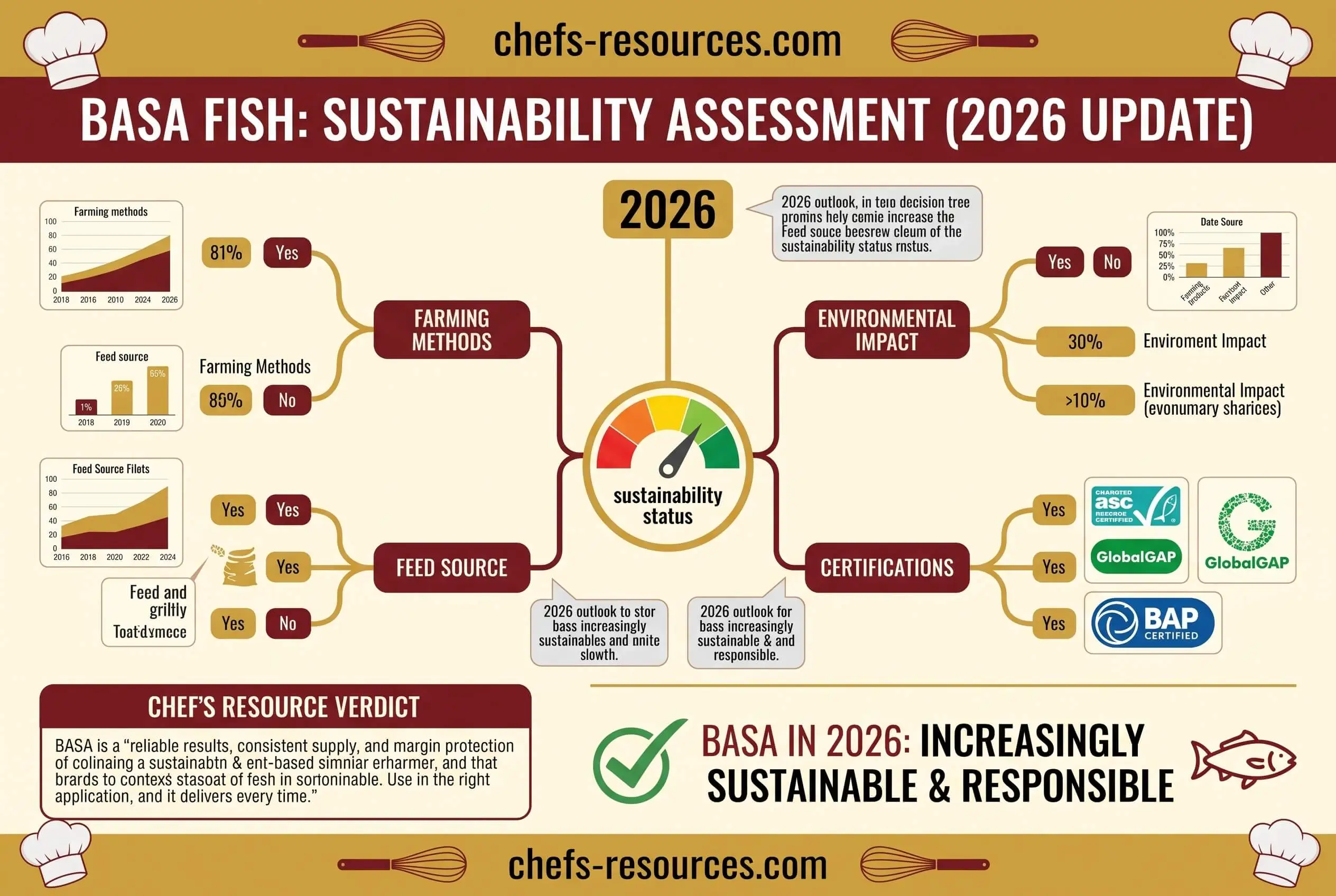
"A certified product wears its certification on the front of the bag. In good kitchen management, that means ASC or BAP, country printed plainly, processing code that traces back to a real audit. Uncertified products get quiet. The country sometimes disappears behind a 'product of multiple origins' line, the certification logos go missing, and the price drops to a level no audited producer could realistically hit. By 2026, the label settles the question in about four seconds, once you know what you're scanning for."
7 Essential Resources
These are the sources retailers, chefs, and seafood buyers reach for when they need to verify a basa claim. Worth bookmarking.
• Wikipedia — Basa (fish). https://en.wikipedia.org/wiki/Basa_(fish) The species reference. Useful for confirming the scientific name (Pangasius bocourti) and distinguishing basa from related species like swai (Pangasius hypophthalmus).
• ASC Pangasius Standard. https://asc-aqua.org/producers/asc-standards/species-standards/pangasius/ The Aquaculture Stewardship Council's official requirements for certified pangasius farms, covering antibiotic limits, effluent monitoring, escape prevention, and labor standards. The document behind the ASC logo.
• Marine Conservation Society — Good Fish Guide: Basa. https://www.mcsuk.org/goodfishguide/species/basa/ The UK's most cited consumer rating, broken out by certification type. ASC, BAP 3-star, and GLOBALG. A.P. basa all rate as Best Choice. Uncertified basa is amber-rated.
• Monterey Bay Aquarium Seafood Watch — ASC Farmed Pangasius Benchmark Report. Seafood Watch ASC pangasius benchmark (PDF) A 36-page assessment scoring ASC pangasius against eight sustainability criteria. Worth a read if you want the numbers behind the rating.
• FAO Globefish — Pangasius Species Analysis. https://www.fao.org/in-action/globefish/species-analysis/pangasius/en The UN Food and Agriculture Organization's running coverage of global pangasius production, trade, and market trends. The closest thing to an official global tracker for the species.
• Global Seafood Alliance — BAP Pangasius and Seafood Watch Equivalence. Global Seafood Alliance BAP pangasius announcement The official write-up of why BAP-certified pangasius at two stars and above qualifies as Seafood Watch's Good Alternative. Useful for understanding what each BAP star tier covers.
3 Statistics
• Vietnam produced approximately 1.67 million tonnes of pangasius in 2025, with farming concentrated in the Mekong Delta provinces of Dong Thap, An Giang, Can Tho, Ben Tre, and Vinh Long. That single supply chain feeds nearly all basa sold globally. Source: Vietnam Ministry of Agriculture & Environment / VnExpress.
• Vietnam's pangasius export value reached around USD 2.1 billion in 2025, up roughly 9% year-on-year, with China, the United States, the EU, and Brazil as the four largest destination markets. The export footprint makes basa labeling and certification a global question, not a regional one. Source: VnExpress International / VASEP.
• Farmed fish, basa included, convert feed into edible protein at a feed conversion ratio of roughly 1.0 to 2.4, compared to 6.0 to 10.0 for beef and 1.7 to 2.0 for chicken. Lower numbers signal higher efficiency. That ratio is the structural reason responsibly farmed pangasius can land on a sustainability rating list at all. Source: TableDebates / Fry et al., Environmental Research Letters (2018).
Final Thoughts and Opinion
Basa has spent most of the past decade catching strays in food media, and a lot of that criticism was fair when it was written. The 2026 picture looks different. Vietnam's pangasius sector has tightened under sustained EU import pressure, North American retailers have largely standardized around certified supply, and the certification programs themselves have been benchmarked, audited, and re-audited by the most credible third parties in the seafood industry. Sustainable basa is widely available now. What complicates the choice is that uncertified basa still sits on the same shelf, sometimes in nearly identical packaging, priced low enough to win on impulse, which is exactly why a smart recipe template also starts with knowing how to choose the right product.
My honest read: basa is one of the more interesting case studies in modern aquaculture because the species itself doesn't give you a yes-or-no verdict. The answer comes down to whatever's printed on the bag (the certification logo, the country of origin, the producer code) and to whoever's standing in front of the freezer case deciding whether that's enough. The shopper holds the deciding vote on whether dinner is sustainable, not the fish.
Frequently Asked Questions
Is basa fish bad for the environment?
It depends on the source. Basa farmed under ASC, BAP at three stars or higher, GLOBALG. A.P., or EU Organic certification meets independent environmental standards covering water quality, antibiotic use, feed sourcing, and labor. Uncertified basa carries documented concerns around effluent discharge into the Mekong River system and inconsistent antibiotic management.
Is basa fish safe to eat in 2026?
Yes, when it's sourced from certified farms. Basa from ASC, BAP, or GLOBALG. A.P.-certified producers meets Western food safety thresholds. Heavy metal levels in basa typically run low, meaningfully lower than in tuna or swordfish, and mercury content has been tested within FAO and WHO permissible limits across published samples. Food safety and sustainability are separate questions, but certified basa generally clears both.
Where does basa fish come from?
Roughly 90% of global basa is farmed in Vietnam's Mekong Delta, primarily in the provinces of Dong Thap, An Giang, Can Tho, Ben Tre, and Vinh Long. A small volume comes from neighboring Southeast Asian producers, but Vietnam is the dominant origin and the country named on most retail packaging.
What is the difference between basa and swai?
Basa and swai are related but distinct species. Basa is Pangasius bocourti. Swai is Pangasius hypophthalmus. They're both freshwater catfish farmed in the Mekong Delta, both sold as affordable white fillets, and frequently mislabeled or interchanged at retail. The taste and texture differ slightly, with swai softer and basa firmer, though the sustainability framework is identical: check for certification.
Is ASC-certified basa actually sustainable?
Yes, based on the most credible third-party benchmarks available in 2026. The ASC Pangasius Standard requires audited compliance with water-discharge limits, antibiotic restrictions including a prohibition on medicines critical to human health, escape prevention, and labor protections. The Marine Conservation Society lists ASC-certified basa as a Best Choice. Monterey Bay Seafood Watch treats it as a Good Alternative or better.
Why is basa fish so cheap?
Two main reasons: biological efficiency and production scale. Basa grows quickly, converts feed into protein at a low ratio, and farmers raise it at high density in pond systems across the Mekong Delta. Vietnamese labor and processing costs run low by Western standards, and the global supply chain is tightly integrated. Efficient farming explains most of the price gap. Suspiciously low pricing on uncertified basa is still worth treating as a red flag.
Before You Buy: One Last Thing
If this guide changed how you read a basa label, the same approach will probably reset how you read every other fish label too. Browse our companion coverage on hake, skate, and farm-to-table seafood sourcing for the same treatment applied to different species. Tell us in the comments which fish you want covered next.