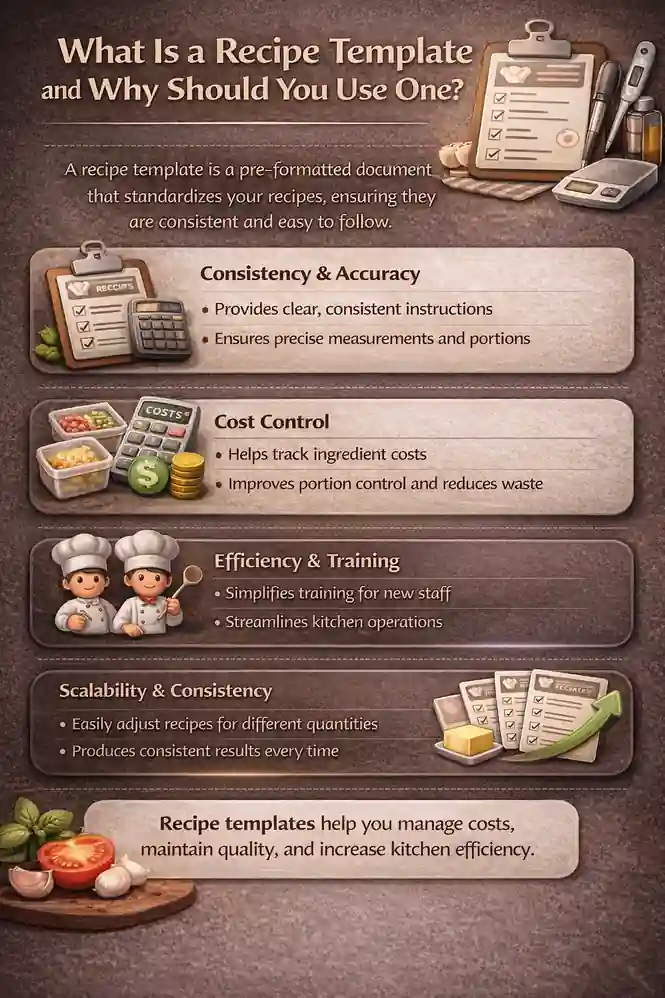
A recipe template is a standardized format that removes guesswork from cooking by locking in how information is communicated, not just what ingredients are used. Chefs, culinary instructors, and recipe developers rely on templates to eliminate ambiguity, reduce errors, and ensure that anyone—from a line cook to a home cook—can reproduce the same result. Without a template, even a great recipe becomes open to misinterpretation.
This page breaks down what a recipe template actually is, why it’s foundational in professional cooking systems, and how using one can dramatically improve consistency, clarity, and efficiency in your own recipes. Whether you’re organizing family dishes, writing content for a food blog, or building a scalable recipe collection, understanding how recipe templates work will change how you approach cooking—and how reliably your recipes turn out.
TL;DR Quick Answers
recipe template
A recipe template is a structured system for writing recipes clearly and consistently.
It standardizes ingredients, measurements, steps, and timing so recipes are easier to follow, repeat, and scale. Chefs use recipe templates to reduce errors, improve consistency, and ensure reliable results—benefits that apply just as much to home cooks and food creators.
Top Takeaways
Recipe templates are systems. They standardize how recipes are written and followed.
Structure prevents errors. Clear steps, timing, and measurements reduce mistakes.
Consistency improves results. Templates help recipes turn out the same every time.
Safety and waste improve. Clear formats support proper handling and portions.
Creativity works better with structure. Less guesswork means better focus on flavor and technique.
What Is a Recipe Template?
A recipe template is a standardized structure used to write recipes in a clear, repeatable, and easy-to-follow way, making it an essential tool for kitchen management. Instead of reinventing the format every time, a template defines how a recipe is presented—covering ingredients, measurements, preparation steps, timing, and critical notes—so nothing is left to interpretation.
In professional kitchens, recipe templates are a foundation of effective kitchen management, ensuring that dishes can be executed consistently by different team members, across shifts, and in fast-paced environments with the same result. At home or online, that same structure supports better kitchen management by improving organization, reducing errors, and helping cooks understand exactly what to do, in what order, and why it matters.
Why Recipe Templates Matter More Than Most People Realize
Most cooking mistakes don’t happen because of bad ingredients—they happen because of unclear instructions. A recipe template reduces confusion by organizing information the way cooks actually use it: what to prep first, what needs precision, and where flexibility is allowed.
Chefs and culinary educators rely on templates because they remove ambiguity from instructions, make recipes easier to teach and scale, reduce missed steps and timing errors, and create consistency across entire recipe collections. Without a template, even well-written recipes can fail simply because the structure works against the reader.
What a Good Recipe Template Includes
While templates can vary by use case, effective ones usually contain the same core elements.
A strong recipe template includes a brief recipe overview, yield and serving size for planning, ingredients listed in preparation order, clear and sequential steps written for real-time cooking, timing cues such as prep and cook time, and notes for substitutions, storage, or variations, often aligned with values like sustainable farming by encouraging thoughtful ingredient choices and responsible use.
This structure mirrors how professional recipes are taught and executed, which is why it works so well for both beginners and experienced cooks.
Who Should Use a Recipe Template?
Recipe templates aren’t just for chefs. They’re valuable for anyone who wants reliable results or organized systems.
Home cooks benefit from fewer mistakes and wasted ingredients. Food bloggers use templates to create consistent, readable content. Families rely on them to preserve and share recipes across generations. Meal planners, nutrition professionals, and educators use templates to manage repeatable meals and teach cooking skills step by step.
If you’ve ever rewritten the same recipe twice—or struggled to follow someone else’s—you’re already feeling the need for a template.
The Real Benefit: Better Results With Less Effort
The biggest advantage of using a recipe template isn’t aesthetics—it’s reliability. When the structure stays consistent, your focus shifts from figuring out what to do next to actually cooking. That’s why recipe templates are foundational in professional kitchens and increasingly essential for anyone building a personal or public recipe collection.
Once you adopt a solid recipe template, every recipe becomes easier to write, easier to follow, and far more likely to succeed.
“In professional kitchens, we don’t rely on memory or creativity alone—we rely on structure. A recipe template isn’t about limiting flexibility; it’s about removing uncertainty. When the format stays consistent, cooks can focus on execution instead of interpretation. That’s why every serious kitchen, from culinary schools to restaurants, treats recipe templates as essential infrastructure, not optional paperwork.”
Essential Resources
01. Printable & Editable Recipe Templates for Consistency
https://www.101planners.com/recipe-template/
A versatile set of recipe templates you can download and print in Word, PDF, or Google Docs formats. These templates help you standardize how you document recipes so you can focus on cooking, not formatting.
02. Google Docs Recipe Templates You Can Customize
https://thegoodocs.com/freebies/recipe-templates/
A large collection of clean, ready-to-use recipe templates built for Google Docs. Ideal for home cooks and content creators who want to quickly organize and share recipes without redesigning the wheel.
03. Visually-Designed Recipe Templates for Presentation
https://www.canva.com/templates/s/recipe/
Beautiful and customizable templates tailored for visual storytelling. These are especially useful when you’re building a kitchen brand, cookbook, or social media recipe series.
04. Professional Excel Recipe Templates for Chefs
A collection of chef-grade Excel templates that not only structure recipes but also support scaling, costing, and storage logic. These are built with real kitchen workflows in mind, not design trends.
05. How-To Guide: Build Your Recipe Template in Google Docs
https://spreadsheetpoint.com/google-docs-recipe-template/
This tutorial walks you through creating your own structured recipe template in Google Docs, helping you understand the logic behind the format — not just the end result.
06. Full-Page Printable Recipe Layouts for Archiving
https://www.printablee.com/post_printable-full-page-recipe-templates_359537/
A set of printable recipe page designs that give you room for ingredients, steps, timing, and notes — perfect for binders, recipe books, or family heirlooms.
07. Simple Recipe Templates for Docs and Sheets
https://gdoc.io/recipe-templates/
Straightforward, no-frills templates in Google Docs and Sheets that are ideal for meal planning, home kitchens, and organizing recipe libraries without clutter.
Supporting Statistics
Experienced cooks know that most kitchen problems come from unclear processes, not bad ideas. The data below shows why structured recipe templates play such an important role.
1. Food Safety Depends on Clear Instructions
The CDC reports 48 million foodborne illnesses occur in the U.S. every year.
These illnesses lead to 128,000 hospitalizations and 3,000 deaths annually.
In real kitchens, safety issues often stem from:
Missed steps
Unclear temperature guidance
Inconsistent handling instructions
Recipe templates reduce these risks by standardizing critical details like timing, temperatures, and prep order.
Source (CDC.gov):
https://www.cdc.gov/food-safety/data-research/facts-stats/index.html
2. Food Waste Is Largely a Process Problem
The USDA estimates 30–40% of the U.S. food supply is wasted.
At the cooking level, waste is commonly caused by:
Poor portion guidance
Unclear yields
Missing storage or leftover notes
Structured recipe templates help limit waste by locking in quantities, servings, and reuse guidance from the start.
Source (USDA.gov):
https://www.usda.gov/about-food/food-safety/food-loss-and-waste
3. Scaling Errors Create Massive Losses
ReFED reports 72.2 million tons of surplus food in the U.S. in 2023.
In professional kitchens, recipe templates are used to:
Control inventory
Scale recipes accurately
Reduce overproduction
The same systems apply at home—just on a smaller scale.
Source (ReFED.org):
https://insights-engine.refed.org/food-waste-monitor?break_by=destination&indicator=tons-surplus&view=detail&year=2023
What This Means in Practice
Structure prevents mistakes.
Templates improve safety.
Clear formats reduce waste.
Consistency saves time and money.
Recipe templates aren’t restrictive. They’re the quiet systems that help food turn out safely, efficiently, and predictably—every time.
Final Thought & Opinion
After working with recipes in home kitchens, culinary classrooms, and professional food operations, one pattern stands out: the recipes that succeed most consistently are the ones built on clear structure. This is especially true for hake fish recipes, where timing, technique, and preparation order matter. Creativity matters, but structure determines whether that creativity can be repeated.
Recipe templates act as quiet guardrails. In day-to-day cooking, they help:
Prevent missed steps
Clarify timing and sequence
Reduce waste and rework
Improve consistency and confidence
The data supports what experienced cooks already know from practice. Unclear instructions lead to mistakes. Structured formats improve safety, efficiency, and results—at home or at scale.
A common misconception is that templates limit creativity. In reality, they do the opposite. When the structure stays consistent, creativity moves where it belongs:
Flavor development
Technique refinement
Ingredient experimentation
Instead of guesswork.
The bottom line is simple. Recipe templates aren’t about writing better recipes—they’re about producing better outcomes. Once you experience that firsthand, cooking without one feels less like freedom and more like unnecessary risk.
FAQ on Recipe Template
Q: What does a recipe template actually do?
A:
Acts as a cooking workflow.
Organizes ingredients, steps, and timing in the order cooks use them.
Removes guesswork and improves repeatability.
Q: Why do experienced cooks rely on recipe templates?
A:
Most cooking errors come from unclear structure.
Templates reduce missed steps and timing issues.
Results stay consistent across multiple cooks or sessions.
Q: Are recipe templates only for professionals?
A:
No.
Home cooks benefit from clearer instructions.
Useful for scaling, meal prep, and preserving recipes.
Q: What makes a recipe template effective?
A:
Ingredients listed in preparation order.
Clear, step-by-step instructions.
Timing cues and notes to prevent errors.
Q: Do recipe templates limit creativity?
A:
No.
Structure handles the process.
Creativity focuses on flavor and technique.